
Where I am standing
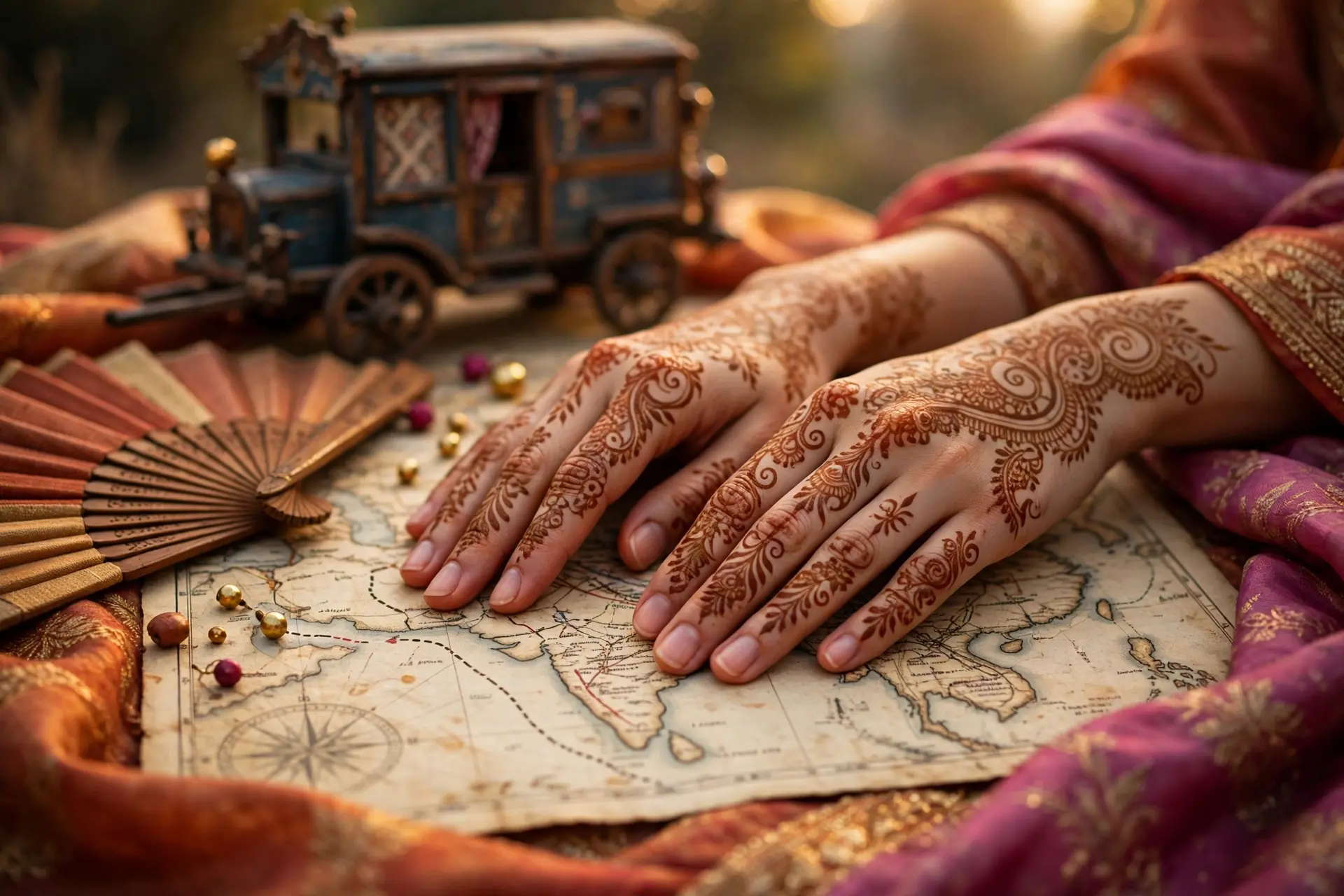
I am a Romaní woman from Barcelona. The Roma people left north-west India somewhere around a thousand years ago and moved west through Persia, Armenia and the Balkans into Europe. That is not folklore, it is the reading of the linguists: Romani is an Indo-Aryan language, closer to Hindi and Punjabi than to any language of the countries we have lived in for centuries.
So when I sit down opposite an Indian bride in a masia outside Girona and draw on her hands, two branches of the same very old journey are meeting again. She travelled from New Jersey. My family travelled for a thousand years. We started in the same place.
I do not say that to claim her tradition as mine. Mehndi as it exists today, the bridal designs, the ceremony, the meaning attached to the darkness of the stain, was developed in the subcontinent and belongs there. My connection explains why the work found me, not why I would have any authority over it.
Which is why I went and trained properly
Feeling connected to something is not a qualification. I trained and earned my certification with Maitri’s Mehndi and with Ash Kumar in London, and I have kept to bridal work since 2018 rather than spreading into everything that can be drawn on skin.
That is the part I would hold anyone to, myself included. Not ancestry. Whether they learned the craft from people who hold it, whether they know what the motifs mean, and whether they treat a bride’s mehndi as her tradition rather than as a canvas.
So can a non-South Asian bride wear henna at her wedding?
At a South Asian wedding, yes, without hesitation. If you are marrying into a family that is celebrating with a mehndi, wearing henna is not taking something, it is joining in.
The test I would use is whether you know what you are wearing and why. A bride who has learned what the ceremony means and is doing it inside that meaning is not appropriating anything.
“I am Indian, but I did not grow up with this”
This one comes up more than the other, and it is sadder. Brides who worry their mehndi will not look “legit enough”. Who grew up in Ohio or Manchester, whose Hindi is patchy, who feel they are performing a heritage rather than having one.
I would gently suggest that a diaspora is not a diluted version of a culture. It is one of the places the culture lives. Traditions that travel change, and the changed thing is still real: I would know, my people have been doing it for a thousand years and nobody has ever handed us the original to compare against.
If it is your wedding and your family’s tradition, it is yours. Nobody is checking your credentials at the door.
What respect looks like in practice
- Know what the event is. Ten minutes of reading changes how you experience the evening. The guide to the pre-wedding ceremonies is a place to start.
- Ask the family. Communities differ, and the people whose wedding it is will tell you gladly.
- Hire people who trained in the craft.
- Never use “black henna” or ready-made, quick-stain henna cones. They have no place in this tradition. They contain chemical dyes that can cause burns and permanent scarring. They exist because they are quick and cheap, but they do not honour the essence or tradition of this art.
Why I Keep Talking About It
Because no bride should feel she has to give up a tradition she loves out of fear of not doing it “the right way” or feeling that she doesn’t belong.
Mehndi has travelled for centuries, crossed cultures and borders, and evolved with every generation. Its essence remains alive, with room for every story to find its own way of expressing it.
Ask, share your questions and explore. I’ll be delighted to guide you and help you experience mehndi in a way that feels authentic, respectful and meaningful to you.
You can read more about how I came to this work on the about page, or write to me with the question directly.
Read next
- Mehndi at a fusion wedding: planning the henna when half the guest list has never seen it.
- Mehndi at an Indian destination wedding in Spain: the full guide to planning the henna for a wedding in Catalonia.
- How to get a dark mehndi stain: what makes the colour deep, and the aftercare that ruins it.